

How the Dholera SIR is Transforming Gujarat’s Economy

Gujarat has always been known as a business-friendly state. From textiles to pharmaceuticals, this western state has built a strong reputation for industrial growth and entrepreneurship. But something bigger is happening right now—something that could reshape not just Gujarat, but India’s entire economic landscape. I still remember the first time someone mentioned Dholera to me. Honestly? I had no clue what they were talking about. Another real estate project, I thought. But boy, was I wrong. Fast forward to today, and Dholera SIR has become one of the most talked-about development projects in India. Not just among real estate folks, but economists, urban planners, and everyday investors are paying attention too. So what’s the big deal? Why should you care? Let me walk you through everything—no jargon, no fluff. Just straight talk about what’s happening in Dholera and why it matters for Gujarat’s future. Dholera SIR: More Than Just Another Project Okay, first things first. What even is Dholera SIR? SIR stands for Special Investment Region. Fancy name, right? But here’s the simple version—it’s basically a massive planned city being built from the ground up. We’re talking about 920 square kilometers of land. That’s roughly twice the size of Mumbai! Located about 100 km from Ahmedabad, this isn’t your typical real estate venture. The government—both state and central—has serious skin in the game here. It falls under the Delhi-Mumbai Industrial Corridor, which is one of India’s most ambitious infrastructure projects ever. Think about it this way. Most Indian cities grew organically over decades or centuries. Roads came later. Drainage was an afterthought. Power supply? Well, we all know how that goes during summer. Dholera flips that script entirely. Everything here is being planned before construction begins. Roads, electricity, water systems, internet connectivity—all designed together. It’s like building a house with proper blueprints instead of adding rooms randomly whenever you feel like it. The Infrastructure Story: This Is Where It Gets Exciting You know what makes or breaks a city? Infrastructure. Plain and simple. And Dholera is getting some seriously impressive stuff. Getting There Will Be Easy Right now, reaching Dholera takes some effort. But that’s changing fast. The Ahmedabad-Dholera Expressway is almost ready. Once complete, you’ll reach Dholera from Ahmedabad in about 45 minutes. That’s quicker than my daily commute in Bangalore traffic, honestly. Then there’s the Dholera International Airport. Yes, an actual international airport! It’s under construction as we speak. When finished, it’ll handle both passengers and cargo. Imagine the trade possibilities that opens up. Metro connectivity is also on the cards. And a dedicated freight corridor will help factories move their products efficiently across the country. Smart City Features Here’s what I find really cool about Dholera’s planning. All utility lines—cables, water pipes, everything—will run underground through dedicated ducts. No more digging up roads every few months for repairs. No tangled mess of wires hanging everywhere. The city will have 24/7 water supply. Reliable power. Proper waste management systems. Even renewable energy integration. These might sound like basic things. But let’s be honest—how many Indian cities actually deliver on these promises? Dholera has a real shot because it’s starting fresh. Industries Are Coming (And Bringing Jobs With Them) Infrastructure alone doesn’t transform an economy. You need businesses. You need factories. You need jobs. And that’s exactly what Dholera is attracting. What Kind of Industries? The region has dedicated zones for different sectors: Electronics and semiconductors (huge demand globally right now) Automobile manufacturing and spare parts Pharma and healthcare products Defense equipment Solar panels and renewable energy gear Several big companies have already announced plans to set up shop here. The state government is sweetening the deal with tax benefits, faster approvals, and subsidized land rates. Here’s the part that excites me most. Where there are factories, there are jobs. Engineers, technicians, managers, supervisors, security staff, canteen workers—the list goes on. Experts estimate Dholera could create lakhs of employment opportunities over the next decade. And where there are jobs, people move in. They need houses. They need schools for their kids. Hospitals. Shopping centers. Restaurants. See how it all connects? One thing leads to another, creating an entire ecosystem. Real Estate: Why Investors Are Paying Attention Alright, let’s talk about what many of you are probably curious about—property investment. Land Values Are Moving Up This is basic economics, really. When infrastructure improves and industries arrive, land prices rise. That’s just how it works. People who bought plots in dholera sir a few years back have already seen decent appreciation. And the real growth hasn’t even started yet. Once the airport opens and more factories become operational, expect another jump. Still Affordable (For Now) Here’s the thing about Dholera that makes it different from investing in, say, Mumbai or Bangalore. Prices are still reasonable. A middle-class family can genuinely afford to buy land here. You don’t need crores to get started. Many families are looking into dholera sir plot booking right now, hoping to get in before prices climb further. I can’t predict the future, obviously. But the logic makes sense—buy early, benefit later. Growing Demand Ahead As workers relocate for jobs, they’ll need places to live. Residential demand will grow. Commercial spaces—shops, offices, restaurants—will become valuable too. If you’re exploring plots in dholera sir, do your homework. Check the location carefully. Verify all documents. And please, work with someone trustworthy. What Does the Future Look Like? Let me be real with you. Dholera isn’t finished. It’s a work in progress. Anyone telling you it’s a guaranteed overnight success is probably trying to sell you something. But here’s why I’m optimistic. Next 2-3 Years The airport should become operational. More expressway sections will open. Industrial units will start production. You’ll see real activity on the ground—not just plans on paper. 5-7 Years Down the Line Population will grow significantly. Schools and hospitals will come up. Residential areas will fill up. Property values? Likely much higher than today. 10+ Years If things go according to plan, Dholera could become a self-sustaining city. A genuine alternative
What Tokyo Electron’s Growing Footprint Could Mean for Dholera’s Next Real Estate Wave

Big industrial moves have a way of changing how people look at a location—sometimes quietly, sometimes overnight. Over the last few months, there’s been more attention on global semiconductor and electronics supply chains, and that has naturally pulled investor eyes toward emerging industrial hubs in India. One topic that keeps coming up in property discussions is Tokyo Electron Expanding its presence in and around Gujarat’s upcoming industrial corridors. Even when details are still unfolding, the direction of travel matters: large technology ecosystems don’t grow in isolation. They bring vendors, logistics, housing demand, and new confidence into a region. In this blog, BHADANI REALTOR breaks down what this kind of development typically signals, why Dholera has become part of the conversation, and how buyers and investors can think clearly (and safely) about the opportunity—without hype. 1) Why “big company movement” matters in real estate How industrial signals shape long-term demand Real estate doesn’t move only because of shiny brochures. It moves because people and businesses actually need space—to live, to store, to manufacture, and to operate. When a large global name is linked to an area, even at the level of expansion planning or ecosystem scouting, it tends to create a ripple effect: More vendor and contractor activity More movement of skilled and semi-skilled workers Stronger interest from service businesses (warehousing, food, retail, rentals) Better visibility for the region on the national investment map The “ecosystem effect” most people miss The real shift often comes from the support network that forms around major manufacturers—ancillary units, supply partners, and service providers. That’s where land demand becomes more layered: not just “plots,” but plots in the right zones, with the right access, and the right timelines. 2) Why Dholera keeps coming up in serious investor conversations Location, planning, and the long-game mindset Dholera Smart City is discussed so often because it represents something many investors look for but rarely find: a planned development narrative tied to industrial infrastructure. People aren’t only betting on today’s demand—they’re positioning for what demand could look like as projects mature. Dholera’s appeal usually comes down to a few practical points: Long-term industrial planning and designated development zones Connectivity improvements (existing and proposed) that can shorten travel and logistics time The “planned city” angle, which often attracts buyers who prefer structured growth over unplanned sprawl It’s not just “a place”—it’s a timeline The most important word here is patience. Planned regions can offer strong upside, but they don’t always move at the pace of a fully mature city. Smart investors treat Dholera like a timeline-based investment: enter carefully, verify everything, and hold with realistic expectations. 3) What a tech/semiconductor-linked expansion typically changes on the ground Jobs, rentals, and day-to-day demand If industrial activity strengthens in a region, the first real estate impact is often visible in: Rental demand (workers, managers, project teams) Small retail and daily-needs businesses Short-stay and mid-stay accommodation needs Transport, logistics, and warehousing requirements Even before large factories operate at full scale, the pre-development and ecosystem setup can create demand pockets—especially near key access routes and commercial clusters. Investor sentiment becomes more “serious” The second shift is psychological but powerful: credible industrial interest tends to pull in more disciplined buyers. And when that happens, people start asking better questions: “What is the zone and land title status?” “What approvals are in place?” “How far is this from key infrastructure?” “What is the realistic holding period?” That’s healthy. It reduces random speculation and improves the quality of market activity overall. 4) What this could mean for plots, homes, and commercial spaces For residential buyers: focus on livability, not just price Residential demand grows when employment and services grow. For homebuyers (especially end-users), the right question isn’t only “Will prices rise?” It’s also: Will daily needs be accessible over time? Is the area likely to develop stable neighborhoods? Can this property serve as a rental asset if plans change? A thoughtful residential buy can balance future upside with practical usability. For plot investors: choose clarity over excitement Plots are often the first choice for long-term investors in planned regions, but they also come with responsibility. The key is to invest where documentation and zoning clarity is strong, and where your holding period matches the ground reality. This is also where discussions about Tokyo Electron Expanding its footprint become relevant—not as a guarantee, but as a signal that the broader industrial ecosystem may strengthen over time, which can support land demand in the right pockets. For commercial/industrial interest: location and access win Commercial success depends less on “city hype” and more on: Road connectivity and transport efficiency Proximity to industrial activity and worker movement Compliance readiness and suitability for intended use If you’re considering commercial property in a developing zone, small differences in location can make a big difference later. 5) Practical checks before you invest (the part most people skip) Verify documentation and approvals—don’t assume No matter how positive the story sounds, the basics protect your money: Verify land title and ownership chain Confirm zoning and usage permissions Check whether the plot falls in a clearly identifiable, legally compliant development area Ask for transparent paperwork—no shortcuts Know your horizon: 2 years vs. 7 years are different investments Planned regions can reward long-term holders, but short-term expectations can lead to disappointment. Decide your horizon upfront: If you need liquidity quickly, choose safer, more mature options If you can hold longer, you can explore growth corridors—but still with due diligence Have a clean exit plan Before you buy, ask: Who is the likely buyer after me? What kind of development will make this location more valuable? What documentation will make resale easier? The best investments are the ones you can explain simply to the next buyer. 6) Why BHADANI REALTOR is the right local partner for Dholera-focused buyers On-ground clarity beats online assumptions Online information can be helpful, but property decisions need local verification. BHADANI REALTOR focuses on helping buyers make decisions based on: real site understanding paperwork clarity suitability to your budget and timeline straightforward guidance without pressure A
Dholera SIR: The Blueprint of India’s Next Smart City

Dholera SIR (Special Investment Region) is often discussed as “India’s next smart city,” but what actually makes it different is not just the label—it’s the planning approach. Instead of growing randomly, Dholera is being developed with zoning, infrastructure planning, industrial focus, and long-term urban needs kept in mind. For investors, the big question is simple: Is Dholera developing in a way that can support real demand in the future—jobs, people, housing, and business activity? In this blog, we’ll walk through the key reasons people are tracking Dholera, how connectivity and DMIC link into its growth story, and what you should check before buying residential plots. Call Now: +917602654981 | Visit Us: www.bhadanirealtor.com Table of Contents Why Investors Are Closely Watching Dholera SIR Strategic Location Advantage of Dholera SIR Dholera SIR on the Delhi–Mumbai Industrial Corridor How Expressway, Airport & DMIC Are Powering Dholera’s Growth World-Class Infrastructure in Dholera Smart City Are Residential Plots in Dholera Worth Buying Now? Social Infrastructure and Urban Planning Governance, Security, and Investment Confidence Who Is Investing in Dholera and What It Means for Growth Employment Growth and Long-Term Potential Conclusion: Why Dholera SIR Stands Apart Frequently Asked Questions – Dholera SIR (Dholera Smart City) 1. Why Investors Are Closely Watching Dholera SIR Investors generally follow two things: infrastructure and economic activity. Dholera SIR comes into focus because it is designed as a large-scale planned region with a clear goal—supporting industrial and urban growth together. What makes Dholera different from “regular” developing areas? It’s part of a structured development vision (SIR framework) It’s planned with industrial zones + residential zones + logistics needs It’s discussed in the context of bigger national corridors (like DMIC) That doesn’t mean every plot is automatically a great deal. But it does explain why serious investors keep it on their radar—because planned regions often create more predictable growth compared to unplanned expansions. 2. Strategic Location Advantage of Dholera SIR Location advantage isn’t just about “near a big city.” It’s about whether a place can practically support movement of people and goods. Dholera’s broader advantage comes from being positioned within Gujarat’s development network—close enough to established economic centers to benefit from them, while still having space for large, planned expansion. Why this matters for real estate If a region improves connectivity and attracts industry, it usually creates: Demand for workforce housing (owned and rental) Demand for local services (shops, schools, clinics) Demand for commercial support (small offices, warehousing, etc.) Over time, that’s how an “investment location” becomes a “livable township.” 3. Dholera SIR on the Delhi–Mumbai Industrial Corridor A key reason Dholera is frequently mentioned in development discussions is its association with the Delhi–Mumbai Industrial Corridor (DMIC) ecosystem. What DMIC means in everyday terms DMIC is basically an industrial growth plan that aims to improve: Freight and logistics movement Industrial clusters Infrastructure planning across key routes When a region is aligned with that kind of long-term industrial planning, it tends to attract more attention from manufacturers, logistics players, and supporting businesses—creating a stronger base for long-term urban growth. 4. How Expressway, Airport & DMIC Are Powering Dholera’s Growth Infrastructure is often the “make or break” factor for emerging townships. In Dholera’s case, discussions frequently revolve around road connectivity, proposed/under-development transport networks, and airport-led potential. Expressway connectivity: why it’s important Better road links can reduce travel time and improve the ease of: daily commuting (future workforce movement) transport of goods site accessibility (which impacts real estate interest) Airport factor: what it changes An airport (when operational and actively used) can boost: business travel access investor confidence demand for hospitality and commercial services The DMIC push adds a long-term backbone Even when real estate cycles go up and down, large infrastructure + industrial corridor planning usually works on longer timeframes. For patient investors, this can be more meaningful than short-term hype. 5. World-Class Infrastructure in Dholera Smart City Let’s put “world-class” into practical, simple terms: it means the basics are planned properly—roads, drainage, utilities, and zoning—so that growth doesn’t become messy. Infrastructure elements typically highlighted in smart city planning Road networks and internal connectivity Water supply and drainage planning Power infrastructure with scalable capacity Digital connectivity support Planned zones for residential, industrial, and commercial use The key point for investors is not just whether these features are “planned,” but what is visible on-ground and what is officially supported through phased development. 6. Are Residential Plots in Dholera Worth Buying Now? This is the question most buyers actually care about—and the honest answer is: it depends on your timeline, your risk comfort, and the specific plot’s documentation + location. Why people consider residential plots here Entry point can be more flexible compared to built property You can hold long-term and build later Plots can suit both end-use planning and investment goals What you should be careful about Not all listings are equal. Before buying, focus on: Clear title and ownership chain Proper demarcation / boundary clarity Approach road and access Layout approvals / legitimacy (where applicable) Seller credibility and paperwork transparency If you want, BHADANI REALTOR can help you shortlist options and understand the practical checks so you don’t buy based only on marketing. Call Now: +917602654981 | Visit Us: www.bhadanirealtor.com 7. Social Infrastructure and Urban Planning A smart city can’t run only on industries and roads. People need daily-life support too. The long-term success of Dholera as a developed township depends on how well social infrastructure grows alongside jobs. What “social infrastructure” includes Schools and learning centers Clinics, pharmacies, hospitals (over time) Local markets and daily-need retail Parks, open spaces, community areas Public services and local administration support Planned development helps because it reserves space and sets direction. But investors should still track real progress over time, not just future renderings. 8. Governance, Security, and Investment Confidence Investment confidence improves when there is: clearer planning and zoning direction more transparency in development phases better coordination across agencies What plot buyers should do on their side Even in strong governance frameworks, buyers must still: verify documents through legal professionals avoid verbal promises without written
Semiconductor Ecosystem is Transforming Gujarat’s Dholera as a Developed Township

Dholera has been in conversations for years—sometimes as a “big plan,” sometimes as a “future city,” and often as a place people are curious about but don’t fully understand. What’s changing now is the clarity. Real, visible progress is starting to connect the dots: infrastructure, industry, jobs, and long-term livability. One of the biggest drivers behind this shift is the rise of the Semiconductor Ecosystem in Gujarat and the serious push to build India’s manufacturing strength. When an industry like semiconductors grows, it doesn’t stay limited to factory boundaries. It creates a ripple effect—new roads, utilities, housing demand, service businesses, and an overall push for planned development. For investors and families thinking long-term, the important question becomes simple: what does this mean for Dholera as a developed township, and how should you approach plot investment sensibly? This blog breaks it down in plain language—what’s happening, why it matters, and how BHADANI REALTOR can help you take the right next step. 1) Why Dholera Is Getting Serious Attention Now (Not Just Talk) Dholera isn’t a random real estate “hotspot.” It’s a planned region under Dholera SIR (Special Investment Region), designed with long-term city planning in mind. That matters because planned development typically brings clearer zoning, better infrastructure alignment, and more structured growth compared to unplanned expansion. Dholera’s location advantage—simple and practical Dholera’s strength is how it can connect industrial growth with wider Gujarat’s economic network. When industries set up in or around a region, the region needs: Reliable road connectivity Power and water infrastructure Logistics and transport support Housing for employees and professionals Commercial spaces for daily needs That’s how a place begins to move from “future plan” to “working township.” The township story is bigger than real estate A developed township isn’t only about buildings. It’s about whether people can realistically live and work there over time—whether schools, markets, medical support, and daily services can grow alongside jobs. When policy, infrastructure, and industry start moving together, demand becomes more natural—not forced. 2) Semiconductors in Simple Words: Why This Industry Changes Cities Most people don’t wake up thinking about semiconductors. But you use them all day: in phones, cars, TVs, appliances, medical devices, and even basic electronics. That’s why countries compete to build chip manufacturing and supply chains—they are essential for modern life. How the Semiconductor Ecosystem creates local demand When we say “ecosystem,” it usually includes more than one unit. It can mean: Manufacturing and assembly units Testing and packaging support Warehousing and logistics Vendor and supplier businesses Skilled and semi-skilled employment And with jobs come people. With people comes demand for homes, rentals, food services, retail shops, transport, and local infrastructure. What this means for Dholera as a developed township Industries don’t just bring machines. They bring movement—daily commuting, business travel, new service needs, and long-term planning pressure. That pressure often improves civic planning and the pace of development, because the region must support both operations and the workforce. This is exactly why Dholera’s township narrative feels more grounded today than it did a few years ago. 3) From Industrial Push to Developed Township: What Changes on the Ground Let’s bring this closer to what people actually care about: “Will Dholera feel like a place you can live in?” and “Will it attract long-term demand?” A developed township typically grows in layers. Here’s how that often happens: Layer 1 — Core infrastructure becomes non-negotiable Industries require basics that can’t be compromised: Strong roads and planned internal networks Stable power supply Water management and drainage planning Telecom and digital connectivity Once these are built to support industrial needs, they also benefit residential and commercial growth. Layer 2 — Housing demand becomes practical, not speculative When employment becomes more stable, housing demand becomes more realistic. Different groups start looking for different options: Workers and technicians (affordable rentals, budget housing) Mid-level professionals (smaller homes, plotted options) Business owners and senior staff (larger homes, premium planning) Plots often become attractive because people want flexibility—build later, build at their own pace, or hold for long-term value. Layer 3 — Services follow the population Once people start living in and around the region, service businesses grow: Grocery and daily needs stores Clinics and pharmacies Schools and coaching classes Restaurants, small offices, repair services This is how “township feel” develops. It’s not overnight—but it becomes steady when job engines are real. 4) What This Means for Plot Buyers: Opportunity, But With a Clear Head With Dholera gaining traction, many people are now asking about the future of plots investment in Dholera—and that’s a fair question. The opportunity can be meaningful, but only when you approach it with the right checks. Why plotted development stays attractive in emerging townships Plots work well in places that are still growing because they offer: Lower entry point than many ready properties (in many cases) Flexibility to build later Potential appreciation if development moves as planned Easier long-term holding (for some investor profiles) But plots also require due diligence. A “good location” is not enough. Paperwork and layout clarity matter just as much. The real drivers of plot demand in Dholera Instead of following hype, watch these practical signals: Connectivity progress (access roads, transport links) Visible infrastructure work nearby Approved planning and clear demarcation Growth of jobs and supporting businesses Demand for rentals and local commerce If these drivers strengthen over time, then the future of plots investment in Dholera can look healthier and more sustainable. 5) A Practical Checklist Before You Buy a Plot in or Near Dholera This section is where smart investors separate themselves from impulsive buyers. If you’re considering a plot, use a simple checklist. 1) Clarify the plot’s status and documentation Ask for clear documentation and verify it properly. Depending on the plot type and location, checks may include: Title clarity and ownership chain Sale deed details NA/NOC status where applicable Layout plan and demarcation Any charges, loans, or disputes (Always consult a qualified legal expert for document verification.) 2) Understand location in a practical way Two plots can be “in Dholera” but
What Is the Future of Plots Investment in Dholera? Growth, Risks & Returns
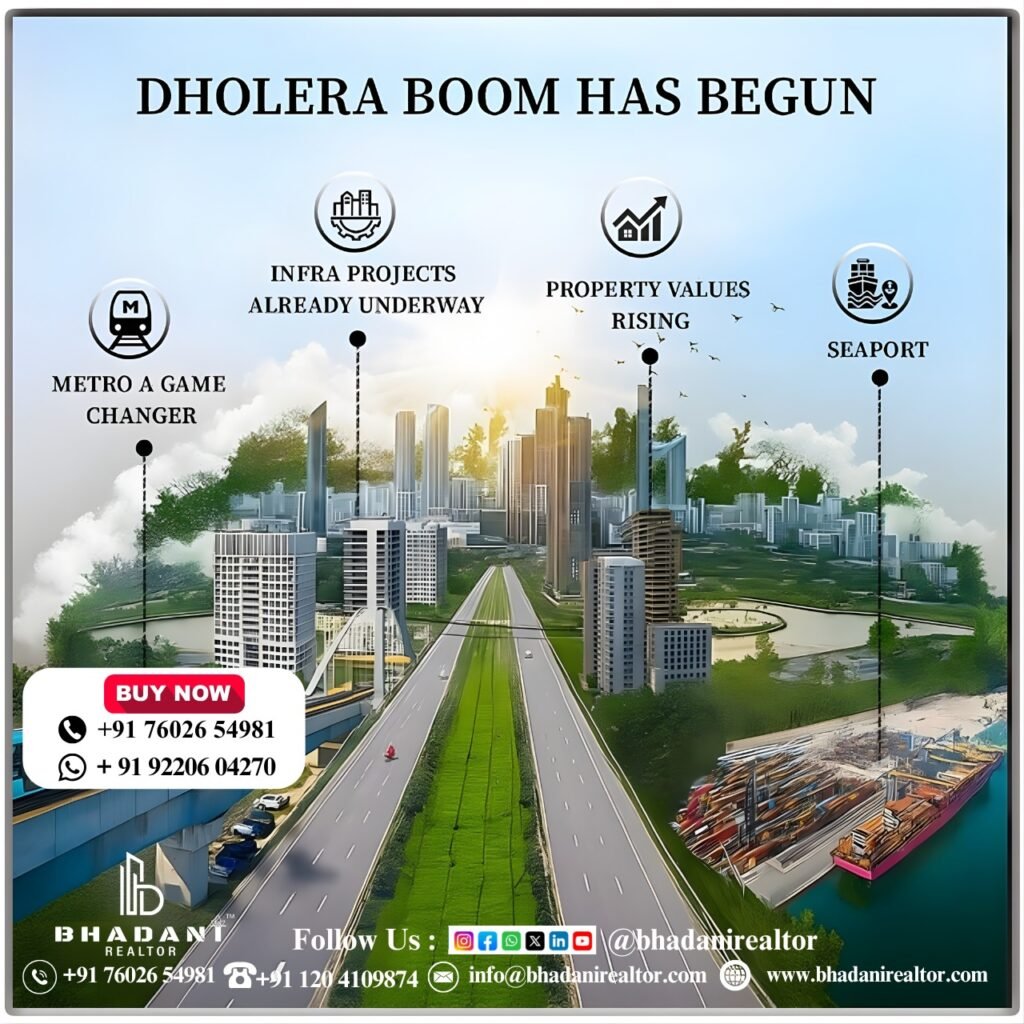
Buying a plot is one of those decisions that feels simple on paper—until you actually start comparing locations, checking documents, and trying to understand what will truly grow over the next few years. If Dholera is on your shortlist, you’re not alone. Many buyers from Ahmedabad, Gandhinagar, and even NRIs are watching this region closely because it’s being developed under a long-term plan. But the real question is: will it translate into actual returns for plot investors—and if yes, what kind of timeline should you expect? This guide breaks down the future of plots investment in Dholera in a clear, practical way: what’s driving growth, what can go wrong, and how to invest responsibly. 1) Dholera in Simple Words: Why People Are Looking Here Dholera has become a regular topic in property discussions because it’s not being developed like an “ordinary” area where growth is random. It’s a planned region, and that planning can influence infrastructure, zoning, and long-term demand. What “Dholera SIR” means (without jargon) Dholera SIR stands for Special Investment Region. In simple terms, it’s an area planned for structured development—roads, utilities, industrial zones, and supporting urban infrastructure—so that industries and residents can move in over time. That’s why many people exploring Dholera investment opportunities consider it a long-horizon bet. But planning alone doesn’t guarantee profits. Your outcome still depends on where you buy, what paperwork is clean, and how long you can hold. 2) Growth Drivers: What Could Increase Plot Demand Over Time When people ask, “Is Dholera good for land investment?”, the best way to answer is to look at what creates real demand. In land markets, demand usually rises when connectivity improves, jobs come closer, and livability improves. Connectivity and infrastructure changes For any developing region, connectivity is the first trigger. Better roads and smoother access from major cities can gradually change the way people perceive distance and convenience. As connectivity and essential infrastructure improve step-by-step, more buyers start considering Dholera not just for “cheap land,” but for long-term ownership in a region with a planned vision. This is one of the core reasons Dholera SIR plots investment is often discussed among long-term investors. Industrial ecosystem and employment pull Land prices don’t rise sustainably just because people “expect” them to. They rise when there’s an economic reason: businesses, jobs, and the supporting population (housing, services, retail, logistics, etc.). If industrial activity grows steadily, it can create a more natural buyer base—end users, small business owners, and long-term investors—rather than only speculative demand. That’s important when evaluating the Dholera SIR real estate future. Planned development (and why it matters for plots) In unplanned areas, you might see patchy development—some pockets grow, some remain stagnant. In a planned region, growth can be more directional. That doesn’t mean every plot will perform equally, but it does mean location selection (zone, approach roads, surrounding development) becomes even more important. 3) Returns: What’s Realistic for Plot Investors? Let’s be honest—most plot buyers secretly hope for quick appreciation. But plots typically reward patience more than speed, especially in developing regions. Short-term vs long-term: set the right expectation If your holding period is 1–2 years, outcomes can be unpredictable. Prices may move, but liquidity (finding the right buyer at the right price) can be limited depending on the exact location and market sentiment. If your holding period is 5–10 years, your chances of benefiting from planned development generally improve—provided you bought a plot with clean documents and decent future access. This is why people researching the future of plots investment in Dholera should think in “phases” rather than months. What can influence the Dholera land price future? A few practical factors matter more than rumors: Exact location and approach road: Plots with better access usually attract buyers faster. Surrounding development: Nearby activity (even basic) can support resale demand. Legal clarity: Clean title, clear documents, and proper verification directly affect resale value. Overall market cycle: Land markets can slow down during uncertain economic periods. Speculation vs real end-user demand: Too much speculation can create price spikes that don’t sustain. A balanced expectation is simple: don’t buy assuming guaranteed appreciation. Buy only if the deal makes sense even if growth takes longer than expected. 4) Risks You Should Not Ignore (and How to Reduce Them) Every emerging market has risks. The good news is that many plot-related risks are preventable—if you follow a proper process. Risk #1: Document gaps and unclear title This is the biggest one. A “good price” is not a good deal if paperwork is weak. Always verify: Title chain and ownership clarity Sale deed details Any loan/encumbrance history Layout and boundary clarity Whether the plot being shown matches documents on ground If you’re exploring Dholera SIR plots investment, treat due diligence as non-negotiable—because clean paperwork is what protects both your money and your resale potential. Risk #2: Buying based on hype, not location logic Two plots in the same broad region can perform very differently. Common mistakes include: Booking far inside with poor access Ignoring basic site realities (roads, boundaries, nearby usage) Choosing “cheapest available” without understanding why it’s cheap A simple way to reduce this risk: shortlist fewer options, visit the site, and pick based on access + surrounding development potential—not on marketing lines. Risk #3: Timeline and liquidity risk Plots aren’t as liquid as apartments. Even if prices rise on paper, selling at your desired price can take time. If you might need money urgently in the next 12–24 months, consider whether plots are the right asset for you right now. Long-hold investors typically do better. 5) Who Should Invest in Dholera Plots (and Who Should Wait) Dholera can be a good fit for certain investor profiles—but not for everyone. Dholera is a good fit if you… Can hold for 5+ years without financial pressure Prefer land as a long-term asset (not quick trading) Want to diversify beyond city property rates Are ready to do site visits + document checks before booking Understand that development comes in phases If your question is “Should I invest in plots in Dholera?”, the best answer is: only if your
